In a world that’s becoming increasingly enamoured with technology, particularly AI, where speed, profits and material status are prioritised and revered over depth, genuine connections and the fostering of/commitment to true excellence, the perceived value of artisanal work, seems to me, to be on a steady and hastening decline.
I have long believed in the beauty and value of handcrafted goods and deeply respect the immense skill and commitment to excellence that many artisans employ to create their work (see this artist’s woodwork and this artist’s work gilding on fabric). The finished product is imbued with a vitality that uplifts the environment in which it is placed and the life of the people around it. It is with this in mind that I focus on learning traditional techniques to create my art work.
Advancements in technology have their benefits, of course, but the speed with which AI, in particular, has been pushed to the fore with triumphant pronouncements of its equivalence to, and potential superiority over, human creativity (and with an expectation of its inevitable sentience) is disturbing.
I choose not to use AI in any part of the creation of my art work (whether that be painting, music composition, writing or sewing) and that was a conscious decision I made as soon as it started to enter mainstream life. I also don’t use it in my daily life preferring to write emails myself or research any topic that I want to learn about with a manual search of online journals and books (and where possible the library). It’s heartening to see that there are projects being run by people who also value a similar way of living and connecting with less reliance on technology (see The Sunday Letter Project).
I think it’s important to retain the skill of being able to critically appraise any information you gather from research (whether you’re using AI or not), to know what questions to ask and how to seek out the answers to a problem without the use of AI. This is a skill that can easily be lost in the pursuit of speed and cost efficiency.
Focused Calm
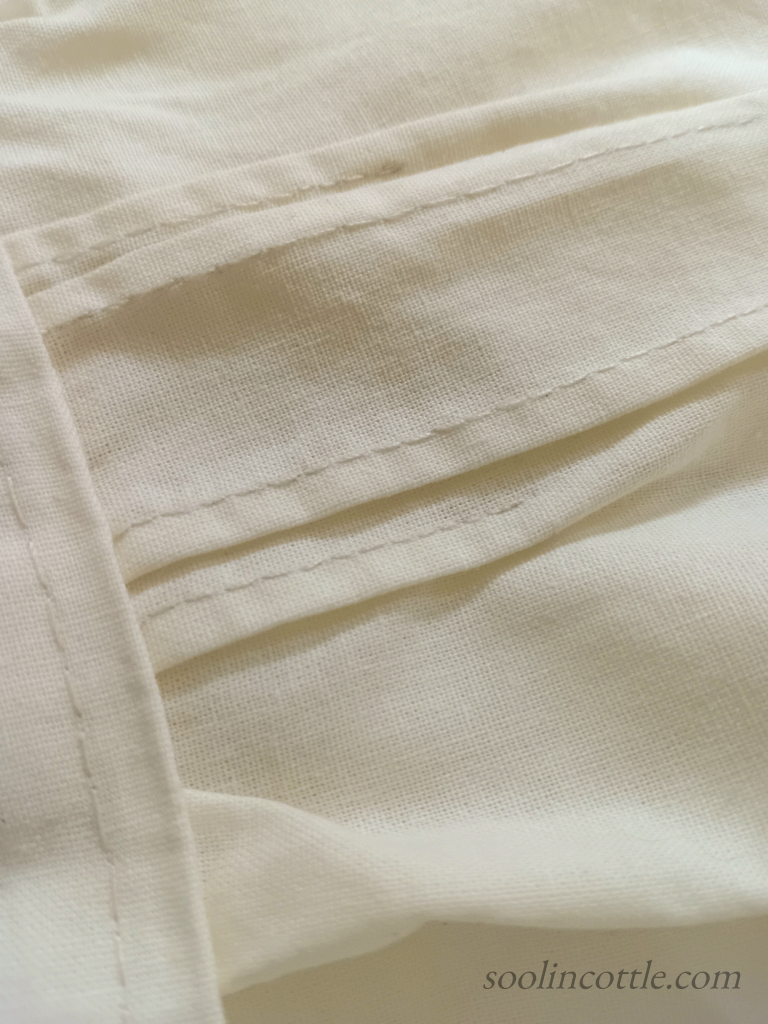
When I first decided to make my own clothes, I knew that I wanted to use natural fibres like cotton and linen and that I wanted to sew them by hand. Part of that decision was because I didn’t have a sewing machine at the time (and I was considering whether to budget for one) but also, I just wanted to see if I could actually sew something by hand. However, as I’ve progressed along my sewing journey I’ve decided not to buy a machine because I enjoy the process of hand sewing so much. It fits in extremely well with my daily responsibilities as a family caregiver (I can pick it up for just 5 minutes here and there throughout the day in between tasks) and once you’ve decided on the stitches you’re going to use, it’s very calming to sit and and sew a long row of stitches along a seam whilst listening to the birds singing outside. There’s also a great satisfaction in working towards creating as neat and even a row of stitches as possible.
Garment Construction & Pattern Making
Creating a garment is an exercise in being able to think fluidly between 3D and 2D. To conceive of a garment in 2D, by creating a pattern on paper, that can then be translated into 3D is a magnificent skill that I admire. Many years ago I attended a free pattern making workshop at the V & A museum that they held during one of their fashion exhibitions. Many of the attendees were costumers and it was fascinating to hear how long it would take them to work on just one aspect of a garment. I distinctly remember the lecturer discussing (and demonstrating) how it could take several revisions of a pattern to get a sleeve to sit just right and how a few millimeters could make a huge difference to the look and fit of the garment. I was in awe of the amount of work and skill this required and it’s funny that almost twenty years later I’m going through a similar process (albeit at a beginner level). I’ve been working on making some basic pattern blocks that I can use to create my own patterns. I started out by drawing the pattern on paper, but it’s tricky to get your measurements accurate by yourself and the first block I made didn’t fit quite right, so I ended up using a combination of draping the fabric on myself and drafting directly on the fabric to create some toiles (see below).
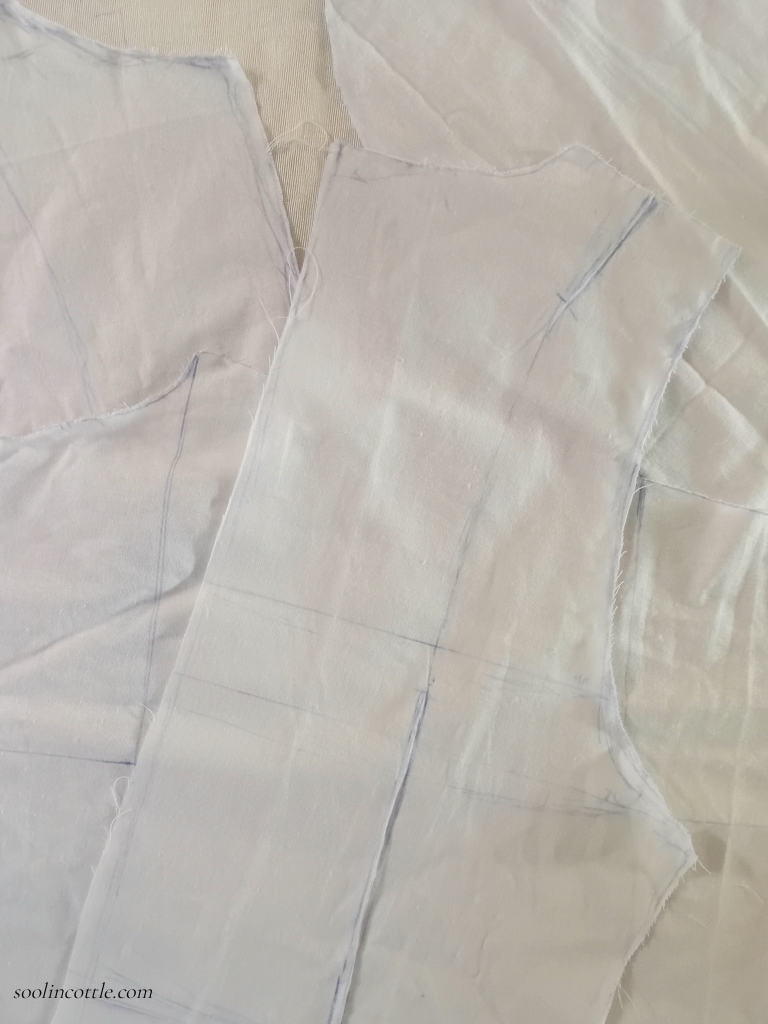
These fit much better and I can use them as the basis for drafting more patterns on paper. Accuracy and attention to detail are vital for pattern making as well as being able to visualise in 3D from a 2D form. I truly appreciate that garment design and construction is absolutely a functional art, which is not really an aspect that is brought out in the commercial fast-fashion world.
The world is currently going through absolute turmoil but, as I wrote in an email last month, not being in a position to have a direct impact on resolving these global upheavals, I feel that developing and drawing on an inner strength, preparing to adapt to changes as efficiently as possible and helping others when in a position to do so, seems like a practical way forward.
How can artisanal work play a role in this?
Investing time into considering the complexities of bringing something born from a creative mind to life in 3D, and developing the skills to do so in a way that brings peace and beauty to others is a genuine form of healing (for the creator and recipient) and a form of service to humanity.